|
Continuing the story of my project!͏ ͏ ͏ ͏ ͏ ͏ ͏ ͏ ͏ ͏ ͏ ͏ ͏ ͏ ͏ ͏ ͏ ͏ ͏ ͏ ͏ ͏ ͏ ͏ ͏ ͏ ͏ ͏ ͏ ͏ ͏ ͏ ͏ ͏ ͏ ͏ ͏ ͏ ͏ ͏ ͏ ͏ ͏ ͏ ͏ ͏ ͏ ͏ ͏ ͏ ͏ ͏ ͏ ͏ ͏ ͏ ͏ ͏ ͏ ͏ ͏ ͏ ͏ ͏ ͏ ͏ ͏ ͏ ͏ ͏ ͏ ͏ ͏ ͏ ͏ ͏ ͏ ͏ ͏ ͏ ͏ ͏ ͏ ͏ ͏ ͏ ͏ ͏ ͏ ͏ ͏ ͏ ͏ ͏ ͏ ͏ ͏ ͏ ͏ ͏ ͏ ͏ ͏ ͏ ͏ ͏ ͏ ͏ ͏ ͏ ͏ ͏ ͏ ͏ ͏ ͏ ͏ ͏ ͏ ͏ ͏ ͏ ͏ ͏ ͏ ͏ ͏ ͏ ͏ ͏ ͏ ͏ ͏ ͏ ͏ ͏ ͏ ͏ ͏ ͏ ͏ ͏ ͏ ͏ ͏ ͏ ͏ ͏ ͏ ͏ ͏ ͏ ͏ ͏ ͏ ͏ ͏ ͏ ͏ ͏ ͏ ͏ ͏ ͏ ͏ ͏ ͏ ͏ ͏ ͏ ͏ ͏ ͏ ͏ ͏ ͏ ͏ ͏ ͏ ͏ ͏ ͏ ͏ ͏ ͏ ͏ ͏ ͏ ͏ ͏ ͏ ͏ ͏ ͏ ͏ ͏ ͏ ͏ ͏ ͏ ͏ ͏ ͏ ͏ ͏ ͏ ͏ ͏ ͏ ͏ ͏ ͏ ͏ ͏ ͏ ͏ ͏ ͏ ͏ ͏ ͏ ͏ ͏ ͏ ͏ ͏ ͏ ͏ ͏ ͏ ͏ ͏ ͏ ͏ ͏ ͏ ͏ ͏ ͏ ͏ ͏ ͏ ͏ ͏ ͏ ͏ ͏ ͏ ͏ ͏ ͏ ͏ ͏ ͏ ͏
|
Sirona Falls February Newsletter!
|
|
The magic of the construction stages where you can just look up and see the sky from inside.
|
|
Hello Everyone, We have made it to February! What a roller coaster already… I am determined to keep my newsletter a distraction from all that, so let’s dive in! Last month the Newsletter was extremely long, and though I will try to keep it under control, I am feeling like long newsletters are going to be a trend. As always, feel free to skim! This month, the Featured Project will be the process of building the Foundation Level/Basement of the house. The Nature Spotlight will be Barred Owls. The Superhero of the Month will be my amazing Mom, Loanne Snavely. I am also going to add back in my Support Me section with a barter opportunity for semi-locals: Anyone want to do a Barter/Trade and do some work with me in exchange for anything that my Dad or I can do for you with our amazing carpentry or artistic skills? More details in that final section, let me know if you are interested. I promise it will be fun work that requires no pre-requisite skills, there are some days my dad and I just need one more set of hands! Hope you enjoy it and more next month! Love, Elody
|
|
I know, I know, icicles are so last newsletter. But with all the cold they got even BIGGER!
|
|
Photographs by Rebecca Lloyd (closeup, left) and Joe Gyekis (context, right)
|
Nature Spotlight: Barred OwlsThis month I want to share about the Barred Owl, our most frequently observed owl species on the property. In fact, when we camp out, we reliably hear them calling almost every summer night, and sometimes partial calls can be heard in the daytime. If you do not know their classic “who cooks for you, who cooks for you all…” song, listen to it here, it is amazing. Only once has one actually been seen, and of course I was not there to see it! A baby Barred Owl was spotted by the cliffs near the waterfalls, captured above by my friend Rebecca and my brother Joe who were there that day. Barred Owl Fun Facts from the Cornell Lab of Ornithology: Barred Owls don’t migrate, and they don’t even move around very much. Of 158 birds that were banded and then found later, none had moved farther than 6 miles away. Pleistocene fossils of Barred Owls, at least 11,000 years old, have been dug up in Florida, Tennessee, and Ontario. Young Barred Owls can climb trees by grasping the bark with their bill and talons, flapping their wings, and walking their way up the trunk. The oldest recorded Barred Owl was at least 26 years, 7 months old. It was banded in North Carolina in 1993, and caught due to injury in 2019.
|
|
My mom and I being utterly fabulous together for almost 40 years.
|
February’s Superhero: Loanne Snavely (Mom)Last month, I introduced you all to my father. This month I want to tell you about my amazing mom, Loanne. Many of you already know her, but you may not know just how fascinating her history is. And while she is not generally wielding power tools, she is equally indispensable to this project. Life Story, in a Nutshell: Loanne grew up, quite literally, all over the world. Though born in Iowa, she spent much of her early childhood in Beirut, Lebanon and Baghdad, Iraq. She spent much of her adolescence in Monterrey, Mexico. (There is a whole other story in that on why that was and who my grandparents were, but perhaps that will have to be in a later newsletter!) She completed her high school degree in Texas so that she would graduate from a school in the US, and then did her undergraduate degree at Juanita College in Huntingdon, PA. She fell immediately and deeply in love with the lush green rolling hills of Central Pennsylvania. Her diverse education took her to Emory University for a MLS (Master of Library Sciences) and later to RIT for an MFA in Ceramics, but eventually those lush hills called her back. Her career was spent as an academic librarian at various universities. She worked at Bucknell University, Bloomsburg University, and then at Penn State. While living in Lewisburg during the Bucknell years, she met Gary and married and they eventually had kids, my brother Joe and I. When she got the job at Penn State University, she commuted for two years while we looked for a place to move to and while Gary built our next family home in Penns Valley, which we moved into when I was 8 years old. At PSU, her love of the arts was united with her library career, as she held the position of Head of the Arts Libraries for many years. Her final position there was the Head of Library Learning Services, which is a fancy way of saying she was in charge of helping the modern student (not knowing a thing about research beyond a google search) to be less scared of libraries and more discerning of informational sources. Rather important work, if I do say so myself! After retiring, the first few years were very occupied with caring for my wonderful grandmother who had a slow and difficult slide into dementia in her final years. With her additional free time, she has had the ability to really rejuvenate her interest in the arts. As I mentioned, she has a degree in ceramics, but she has always been a very skilled and artistic person in many media. Her art practice focused mostly on drawing, and as a talented calligrapher her sense of line is simply lyrical. But in recent years her interest in painting has exploded (I can take a little credit here!) and she has become a prolific and colorful painter of nature, and we have been able to do a lot of plein air painting together. I tell you about her life story and career, because her willingness to have a “real job” with all of the benefits that came with it, has had a huge impact on our family, providing for us in so many ways. Her career is what made this project possible financially. Since they owned their home outright, our construction loan was financed entirely by taking a loan against their home, which was an unbelievably generous thing for my parents to do. Now, my mom’s retirement savings are also getting involved in keeping the project going. In addition to all of this enormous financial support, my mom has taken charge of the stressful and confusing work of managing all of those finances… applying for the loan in the first place, and keeping us on track with keeping up with all of the loan payments and construction bills. It is thankless but important work that keeps it all going, and I am grateful beyond measure. So, she helps with the worst and most difficult logistics. But never fear, I also bring her into the most fun parts of the project! She has helped a lot with some of the finer artistic work of the project, putting her skills to use with projects like the fancy decorative trim. She painted the gorgeous sunflower door trim, pictured below. As you can tell, I am the luckiest person alive to have such incredible and supportive parents. This is truly a family endeavor and none of it would be happening without them. (Not to mention, my mom’s employment at PSU is the reason that both my brother and I went there, taking advantage of the tuition discount given to family of employees, and earning scholarships besides. This undergraduate education and lack of debt afterwards is what allowed me to dive headfirst into the life of an artist, figuring it out as I went without the pressure of crippling student debt.) Are these profiles of my parents helping any of you understand why I am the person I am? My childhood parental influences meant that I spent a lot of time playing with wood scraps and climbing around on scaffolding like it was my personal playground equipment, and exploring libraries and looking at art books. Not to mention running around the forest, reading books, and drawing flower fairies. What was not part of my childhood? Any screen time. We had no TV. Entertainment was each other, books, art, and nature. I know, I had it rough!
|
|
Loanne designing and painting the flowers and butterflies for the “sunflower doors”, a close-up, and the finished installation.
|
Feature Project: Foundation/Basement LevelWho, What & When: Before I begin, I want to acknowledge not just the how but the who. As you might guess, my father and I were not quite up to the task of building a whole house all by ourselves. For much of 2023, while we still had money from our construction loan, we had a crew of three additional people. They are all friends of ours: Chris, Kenny, and Seth. Their widely diverse skills and physical strength were absolutely indispensable from foundation to roofing, helping us get the main structure and skin of the house built. More on them next newsletter. When designing the house we went back and fourth on whether we would do full basements and ultimately decided to do so. The relatively compact nature of the design left little room for closets and storage, and the slope of the property leant itself to having walk-out basements on the downhill side. Ultimately it became clear that it made the most sense to do full basements on both sides. This stage was from April-June of 2023 First Step - Lego blocks! Last newsletter we left off with the first layer of the foundation done: piers and sub-walls where all things weight-bearing would be, poured concrete and rebar. The next step was the walls themselves. To do this, we used a relatively new material for basements, called ICF blocks (insulated concrete forms.) Basically, they are super cool interlocking hollow foam blocks, where the foam functions as both insulation and concrete form at the same time. They come in sections with shaped edges that lock together like lego blocks. Plastic spacers hold the foam sides apart, creating the hollow space inside for the concrete. Building the “lego” walls was very fast, but there was much more to do before the concrete pour could happen. Lots and lots of rebar had to be inserted inside to make it structurally sound.Then, additional giant braces (loaned from the same company that sold us the ICFs) had to be put on the inside and outside of each wall as additional support, so the foam walls would not simply explode outwards or collapse from the weight of the wet concrete being poured inside.
|
|
Left: Building the walls with ICF blocks. Video here. Top Right: Temporary bracing. Bottom Right: Looking down into the hollow ICF blocks with the spacers and rebar.
|
|
Second Step - The Big Pour! This was another very exciting “big day” for the project, one of the few days that involved more than just our usual crew. A big truck with a pump and an enormous extension arm transported the concrete through a tube that could be directed very precisely to any part of the foundation. The truck parked in one place and the arm squirted the concrete directly down into each wall form, moving the tube along the top edge until filled. When the cement truck that was hooked up to it was emptied, another full cement truck would pull up and connect to it. We went through three trucks worth of cement! It was crazy! Timelapse video of the process here and photos below.
|
|
The big pour in action! Watch the video as well, the time-lapse is very “Pixar lamp”.
|
|
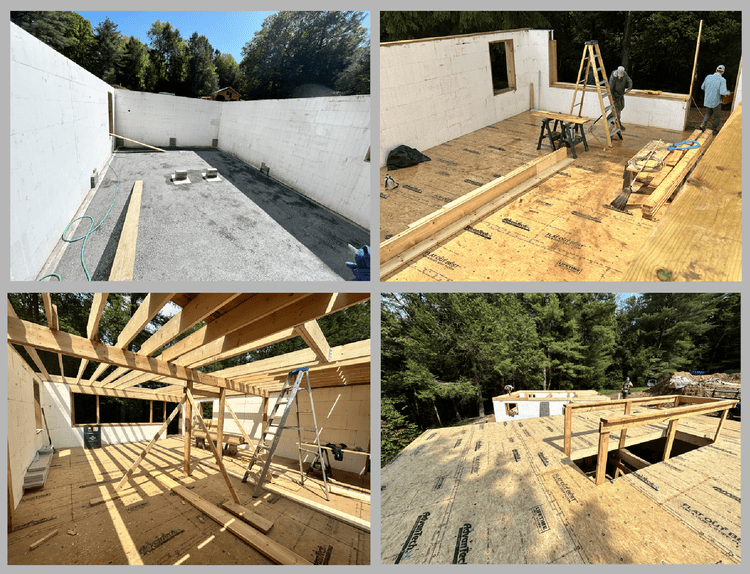
Third Step: Floor/Stairs/Ceilings Once the walls were poured and the external supports removed, the basement floor needed to be addressed. First there was a layer of gravel poured in, packed down, and leveled, and then a wooden floor was built above it. Finally, the ceiling above/floor of the first floor was built, and the staircases on both sides to connect the basement to the first floor. (Every time it rained, from this point until we had the final roof over the whole building, water would pour into the basements and collect in puddles on the floors. I spent a lot of time sweeping water out of the two basement doors on either side!) Ta-Da! First level is roughly in place.
|
|
Upper photos: Progression from gravel subfloor to basement floors. Lower photos: Joists and subfloor for basement ceiling/first floor.
|
|
Top Row: Building the staircases that connect the basement and first level. Bottom Row: Not mentioned in the narrative, we also had to wrap the foam walls with black plastic “dimple mat” where the earth would touch it before back-filling.
|
|
P.S. Update to last month’s newsletter, I got some better photos of the first house my Dad built for our friends Steve and Lucie. Exterior and Interior below.
|
|
|
|